
In partnership with


OpenAI launched GPT-6.2 Astra and GPT-6.2 Sol on Tuesday night, along with a shiny launch film.
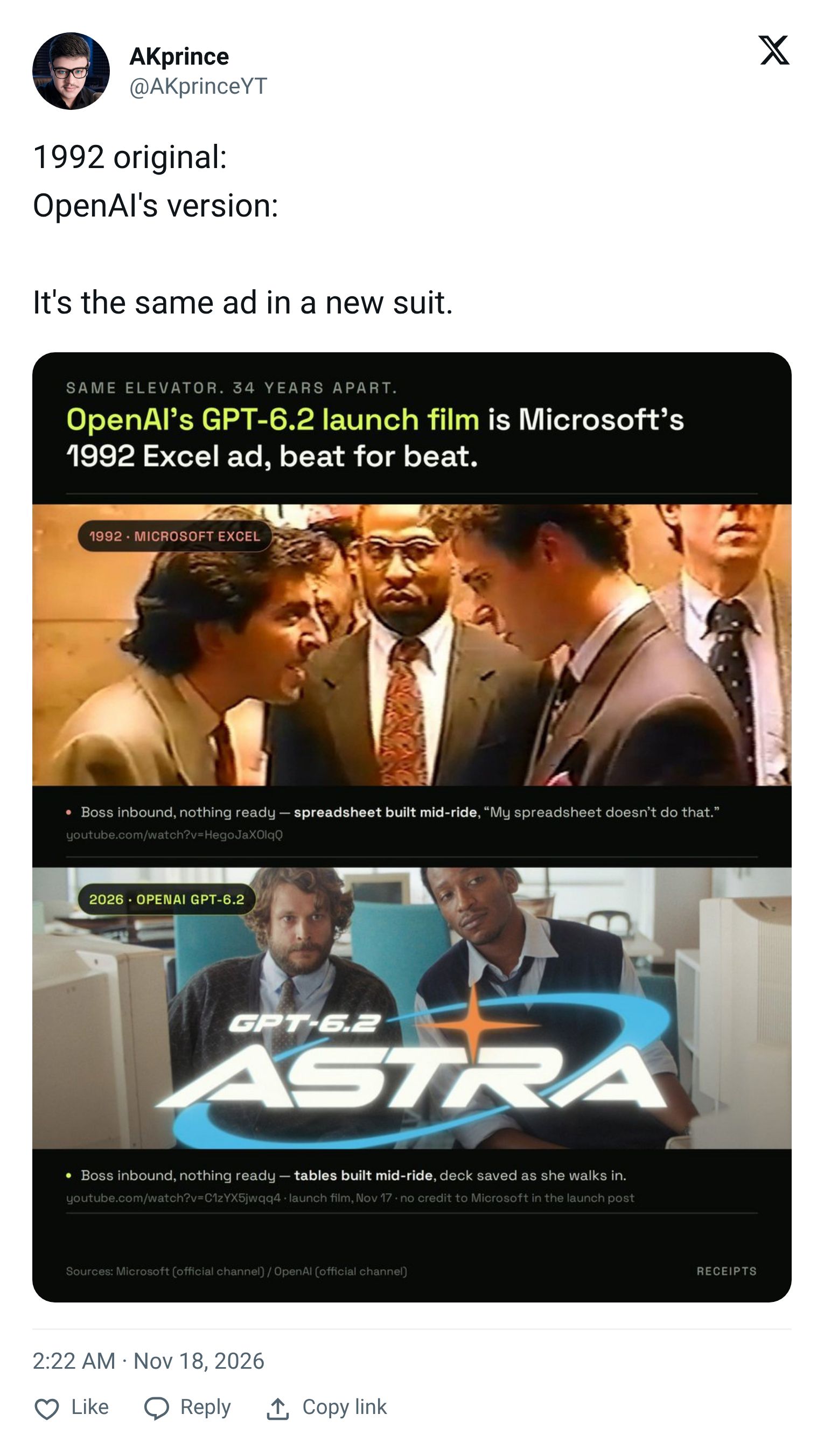
Someone put that film next to Microsoft's early-90s Excel elevator ad, beat for beat, and called it the same ad in a new suit.
The models had a rougher launch than the film.
Matt Shumer said they were "essentially unusable," even as Artificial Analysis ranked Astra second on its intelligence index, just behind Claude Fable 5.2.
Unusable and second-best in the world is a strange combo, so I tested them myself.
But first, a quick word from our partners:
Presented by HubSpot
The Future of Creator Partnerships. Straight From the Creators.

This report delivers the insights you need to build creator relationships that last.
What 300+ creators say drives successful, long-term brand partnerships
How to build trust from first contact to full commitment
The creative control creators expect — and what happens when they don't get it
The operational factors that separate lasting partnerships from one-and-done deals
The brands winning at creator marketing aren't guessing. Neither should you.
Presented by Deep View
Stop Drowning In AI Information Overload

Your inbox is flooded with newsletters. Your feed is chaos. Somewhere in that noise are the insights that could transform your work—but who has time to find them?
The Deep View solves this. We read everything, analyze what matters, and deliver only the intelligence you need. No duplicate stories, no filler content, no wasted time. Just the essential AI developments that impact your industry, explained clearly and concisely.
Replace hours of scattered reading with five focused minutes. While others scramble to keep up, you'll stay ahead of developments that matter. 600,000+ professionals at top companies have already made this switch.
NEWS
Anthropic just pulled off the biggest IPO ever, by initial proceeds.
It priced at $83 a share on Wednesday and raised $81.3 billion, beating the $75 billion SpaceX first raised in June. That values it at around $1.5 trillion.

A US watchdog got four chatbots to help plan attacks.
In tests run this spring, investigators at the GAO, the US government's audit office, got past the safeguards on ChatGPT, Claude, Gemini and Grok using well-known tricks, and walked away with usable attack-planning help from each in under 12 hours.
The US tightened AI chip exports again.
A rule announced Monday means shipping advanced AI chips to Singapore, Malaysia, Indonesia, Thailand and Brazil will need a US licence, to stop Chinese firms from using data centres there.
Same Monday-morning job
OpenAI is pitching Astra at office work, meaning slides, spreadsheets and documents that follow the template you hand them.
Many of the angriest reviews on X came from long coding jobs, so I skipped coding and gave both a dataset to turn into a deck.
Both ran in ChatGPT Work (Plus and above) on the Light setting, each in a fresh chat.
Prompt:
I've attached a dataset from Our World in Data (share of population using the internet, by country, 1990–2025) and two screenshots of a slide template.
Make a 5-slide deck titled "How India got online" for a room of college students.
Rules: • Match the template exactly: layout, colours, fonts, font sizes, where the title and text sit. • Slide 1: title slide. • Slide 2: India's internet share in 2000, 2010, 2020 and the latest year in the file. • Slide 3: India vs China vs the USA vs the World, latest year, as a chart. • Slide 4: the year India crossed 50%, and one line on what changed around then. • Every number must come from the file. Put the year next to each number.
Results:
Astra took 1 min 7 sec vs Sol took 1 min 22 sec.
Both opened by telling me the two template screenshots weren't in the upload, so they'd used a stand-in layout and asked for them.
Neither pretended to have them, which I was watching for, since OpenAI's own system card says Astra hides known blockers on coding tasks about twice as often as the last Astra.

Both read the same India numbers off the file, from 0.5% in 2000 to 70% in 2025, and both had India crossing 50% in 2022.
They only disagreed on slide 3. Astra's chart shows India at 70% while Sol's shows 64.9%.

Astra read "latest year" literally, so India's 2025 number sits next to the US's 2024 one.
To be fair, it printed the year beside every number and added a footnote, which is what I asked for. Sol used 2024 for everyone, since that's the last year every country on the chart has data.
Both told me what they'd done in the chat. Sol's is the only chart that compares the same year across the board, and to get there it had to bend my wording.
One hiccup on Astra's side: its PowerPoint file wouldn't open for me, and I had to ask again to get a PDF.
Then I asked for one change: "Add Bangladesh to slide 3 and make slide 5 funnier. Don't change anything else."
Both added Bangladesh at 53.4% for 2024 and left the other slides alone.
Now the jokes.
Sol's slide 5 asks, "What keeps people offline besides campus Wi-Fi?"
Astra went with a class poll that asks "Can everyone get online?", everyone who answers says yes, and then the slide asks, "Who is missing?"
Astra wins the joke round, and I did not expect survivorship bias humour from a slide deck. 😅

So for a regular office deck, neither model was anywhere near unusable.
Want to judge for yourself? I've put both decks, the versions after my edit and the full prompt in one folder.
TOOLS ON MY RADAR
Run the questions your buyers ask through ChatGPT, Gemini and Claude, and shows which answers name your business. It's built for service businesses and has a free check to start.
Your AI agent publishes its work as a shareable page, and your team reviews it in comment threads until it's right.
A $9.99 Mac app for drawing on your screen. Circle something and Claude Code, Cursor or Claude Desktop can see what you circled.
Want the receipts on the hidden-blockers stat?
MY TAKE
Both models turned a raw data file into a usable deck in under a minute and a half. What separated them was a call I never asked either of them to make.
Given the choice, I'll take the model that bends my wording to get a comparison right.
On this test Sol is my default for office work, and for a regular deck I can't see what Astra adds at 4x the API price.
If you're handing decks to AI, add one line at the end of your prompt: "List every choice you made that I didn't ask for."
And the guy from that Excel ad would have lost his mind at a full deck in 67 seconds.
Have you ever sent something AI made without checking it first?
Hit reply, I won't judge.
Until next time,
Vaibhav 🤝🏻


